What follows is an account of my life-threatening ordeal in the Caucasus
Mountains of (Sochi) Russia on Sunday, February 15, 2015. I have, for the most part
recovered, and write this some five and six weeks later from several warm, sunny beaches
in SE Asia.
Around 2:00 p.m. on the 15th, I was skiing alone at the Gornaya Karousel resort (elevation
2,300 meters – 7,545 ft.), which is one of four Russia ski resorts in the Krasnaya
Polyana Valley (elevation 540 m – 1,771 ft.; i.e., a vertical drop of 5,774 ft.),
approximately 45 miles from Sochi, on the Black Sea. Many of the 2014 Olympic downhill
events were held at the Rosa Khutor resort (elevation 7,611 ft.), located a few kilometers
to the West.
I had chosen Russia due to the precipitous decline of the ruble. $100 lift tickets a year
ago during the Olympics were now $24. This was my first ski trip in many years; it was an
exquisite day, the sun shining, in the 40’s (F). The sun had come out after a week of
clouds; the first real look I got at the mountains. Because it was relatively warm, I did
not wear ski pants or heavy gloves, and instead wore jeans and just thin glove liners. To
me, being too hot when I am skiing is as bad, or worse, than being too cold.
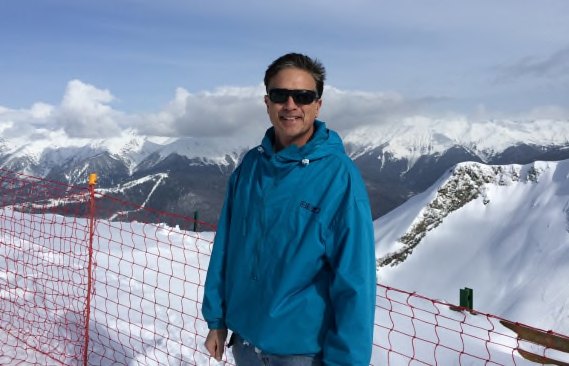
Here I am just before the events described below.
The Trail That Ended
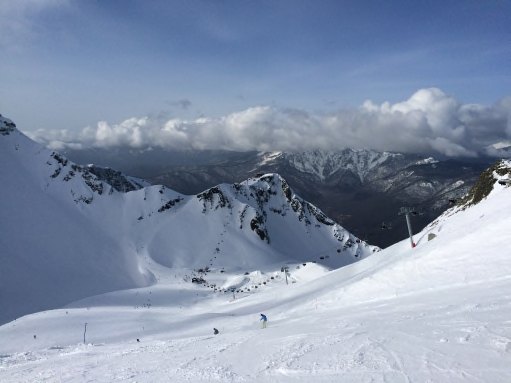
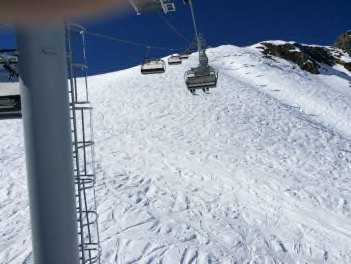
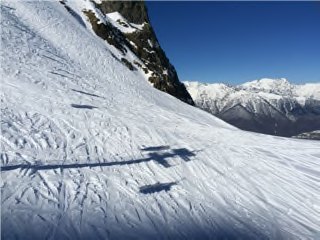
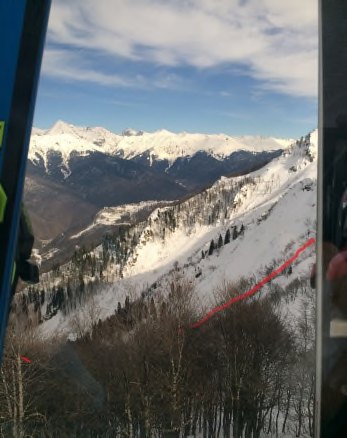
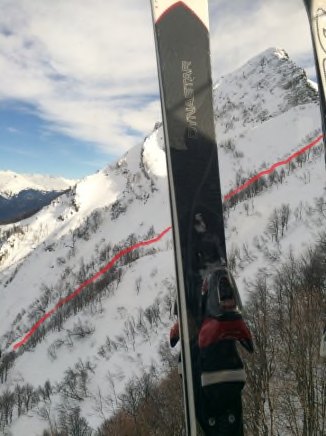
After a few runs on groomed trails, I took what looked like a trail, below. Notice the
absence of any warning signs, gates or ropes. I have never gone, nor will ever go, past
same. The first two pictures were taken from Lift 3, which is the closer lift in the third
picture. The skiers in the third picture are moving to the left, which is where I was
headed.
No warning signs, gates or ropes. Taken from Lift 3.
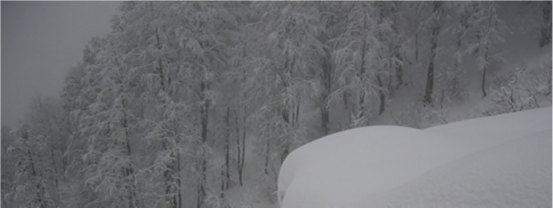
After a few minutes, and descending maybe a few hundred vertical feet, the nice, wide-open,
powdery trail abruptly ended in an area of trees, which had a very steep pitch and very deep
snow, making it too difficult for me, and so I took off my skis and started to walk down.
That soon became too difficult, and I started to try to slide down on my rear, planting my
skis and poles for support. That quickly became futile, as I found myself going over an
extremely steep precipice, somersaulting twice, falling probably 30–35 feet, and,
thankfully, landing in enough snow that I was able to stop myself from tumbling further (as
opposed to continuing to gain momentum and hitting my head on the many nearby trees).
A Google Earth photo from the approximate area, taken by someone else who
apparently had made a similar mistake. I was able to position myself further from the
50–60 foot trees seen here, to the left, to a somewhat more open area.
I was bruised, a bit shaken, but suffered no breaks. I brushed myself off, looked back up
the mountain and saw my skis about 35 feet above me, took one step in their direction, and
immediately gave up on them, having just begun to understand the seriousness of my
situation.
I realized that I was outside the bounds of the ski area; thus, there would be no ski patrol
available to aid me. Moreover, my phone/camera had been smashed by the fall, but that
mattered little, as it was not configured to make local (Russian) calls, and in any event I
had yet to learn the Russian emergency number (112). Of course, the language barrier would
have been yet another impediment (although many Russians do speak some English), as would
the fact I had little idea where I was (somewhere between Gornaya Karousel and Rosa Khutor,
up high).
I realized that there was only one way out of my problem — figuratively and literally.
I would have to descend several thousand (5,200) feet over several horizontal miles in my
ski boots and hopefully get to a road by dark. It was then about 2:30 p.m. I had less than
four hours to sunset.
Skiers are aware that a “head-on” photo does not give a true sense of
a trail’s steepness, as do photos like these. Still, when you get there, it is always
steeper than it looked from down below or the lift.
Further complicating matters was the fact that I could see that the valley I was in
eventually narrowed to the point where I would have to go in a stream that ran down the
easiest (as water always does), and only viable, path. Though it was not frigid, the dangers
of hypothermia made it vital that I avoid entering the stream for as long as possible. While
Sochi is not Siberia, it was unknown how long this journey would be, and I worried about
spending a night on the mountain while wet. This became a powerful motivator. (“The
only way I am getting dry tonight is if I find a road, get to civilization.”)
A Journey of a Thousand Miles
I set off trying to “crab-walk” and slide along on my rear due to the steepness,
but, not wearing smooth ski pants, and just absorbent (i.e., wet) denim, sliding became
difficult. The impact on my “abs” was akin to the burn of several hours of
exercise. The muscles in my legs, arms and abs began to cramp and burn, as it was very tough
going, especially in the beginning where the air was thinner.
I had no choice but to ignore the pain, and would break down the climb into segments of a
few hundred yards at a time, perhaps 20 minutes each, so as to give myself an achievable
goal. The thought of the entire journey, unknown as it was, was far too daunting. I
remembered the Chinese proverb, “a journey of a thousand miles begins with a single
step.” I just had to keep putting my left foot in front of my right foot (single steps
will ultimately get me down). I also thought of the movie “American Sniper”,
which I had recently seen, and I said to myself, “You are as f-ing tough as those Navy
Seals. (For today anyway, you have to be).” I also kept singing (out loud) an old
disco favorite, “Born to Be Alive.”
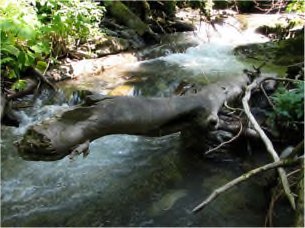
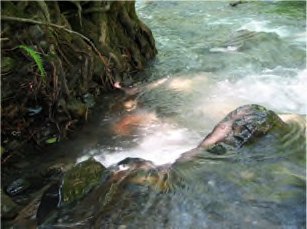
Eventually I had to enter the stream. It is big enough to have a name — Rzhanaya;
maybe it’s a little river.
The Rzhanaya, photographed in spring and summer by a Russian. In February it was
snow melt, roughly 32 °F.
While the water was probably about 32 degrees (F) (snow melt), perhaps it was my adrenalin
that kept me from feeling the cold, despite the fact that at times, I was in up to my waist.
It was incredibly rocky and uneven, and thus every step was slow, difficult and painful,
although made possible by the fact that I was in ski boots, which took a lot of punishment.
Some of the time, it was so steep that I could not walk, and had to lower myself down using
the branches as ladders, hang a bit, then drop and hope for the best.
Suffice it to say the journey sapped all of my mental and physical strength. It reminded me
of stories I had heard of herculean feats in an emergency, as when someone is able to lift a
car to save someone pinned beneath it. Adrenalin yes, but even more than that, it was just
sheer determination, the determination that recently allowed me to litigate a case basically
by myself for seven years and get a million-dollar settlement from some of the arch villains
of Wall Street and their white-shoe (thug) lawyers. “Bruce Kaplan has a goal to meet
(find a road, get down tonight), end of story.” That really was my main, narrow,
steely focus, and my body had better keep up, however battered. My brain had little room for
anything else.
So often I thought I had caught a glimmer of civilization (maybe a pole, a hut, a trail),
but it always turned out to be a mirage. While I knew I was descending, I also knew that the
slope I was on was bringing me further to the West of the ski resort I had started at, i.e.,
seemingly further into No Man’s Land, as there continued to be no signs of people. I
was struggling, step-by-step, inch-by-inch, through a craggy, and at times, deep, stream.
While I assumed the stream would eventually flow into the river that forms the valley in
which the ski towns (and my warm, dry hotel room) were located, I had no way of knowing
where that confluence was in relation to my hotel or how long it would take to reach. The
length, scope, of the valley is about 15–20 kilometers. While I aimed for the shortest,
most direct route, the slope frustratingly brought me further and further to the West (right)
of where I wanted to go, significantly lengthening the trip.
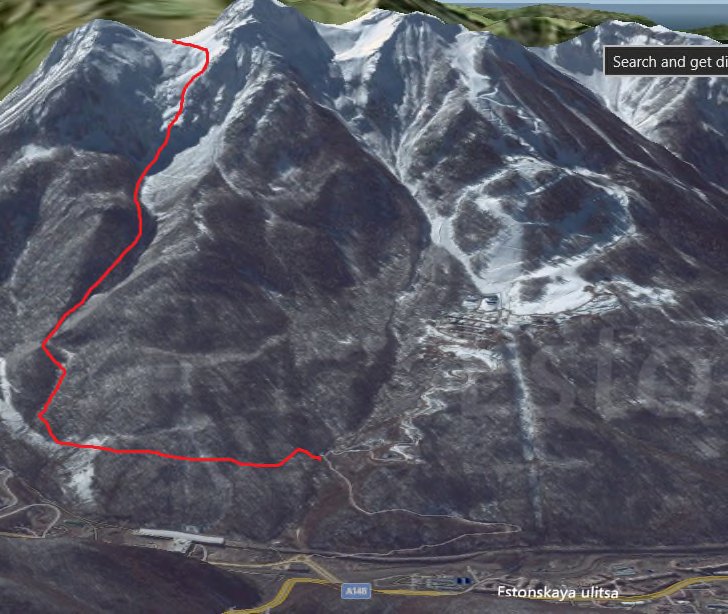
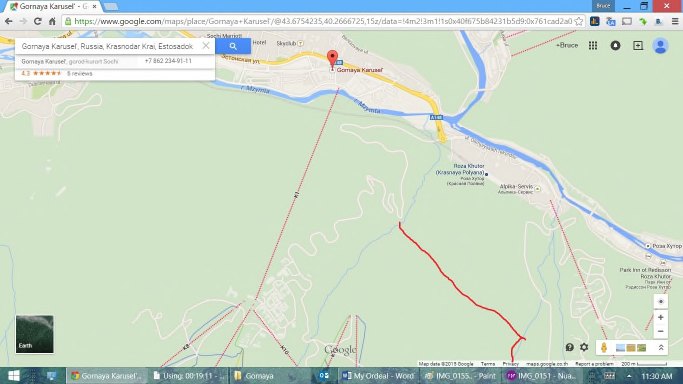
The route out, in red — from the ridge above Gornaya Karousel down to the
valley floor. Roughly five to six miles, on foot, in ski boots.
Fifty-Fifty
Progress was slow; several hours passed; the light faded; the slog continued. I began to
consider the real possibility that this day might be my last; for several hours, I gave
myself a 50/50 chance. (“It’s possible you may not make it out of here. This is
how it ends, over a missing sign? What B.S!”). I started to ask something from God,
then remembered that I really don’t believe in Him/Her. (“All right, the hell
with you, I do this myself.”)
“Some people drop from a ski area into a wilderness that has no exit route, so there
are only two outcomes at that point: They’re going to die or pay for a rescue —
unless they’re extraordinarily well-equipped.”1 Thankfully, I was on the side with an exit, and found a third outcome.
Yet, I was then thoroughly overwhelmed by my insignificance, perhaps because I was in such a
vast natural setting, along the lines of T.S. Eliot’s: “This is how the world
ends; not with a bang, but a whimper.” I wasn’t scared; I just felt nothing,
stared into nothingness, irrelevance, insignificance.
Several weeks later, I related my experience before one of the “A-list” gurus at
the International Yoga Festival in Rishikesh, India (where the Beatles had visited in 1968).
I told him that while I “contemplated the other side” during my ordeal, I must
have arrived at the anti-Nirvana, or maybe Seinfeld’s Nirvana, because all that I
could feel, see (figuratively) was nothingness. No angels, no bright light, no Stanley
Kubrick/2001-type kaleidoscope revelations about what it all means; just a void. He said I
had “reached the end of the road, figuratively (and later, literally)”, and had
looked into, had arrived at, a “spiritual black hole”. He further related that
“there is an account” of five nuns somewhere who, having isolated themselves
from everything, just prayed and reached such state of nothingness. Fine. Whatever. The yoga
helped me to limber up.
Maybe it was like when a kid in Wisconsin falls through the ice of a lake in January, and
his metabolism slows to a state of suspended animation that allows doctors to revive him
several hours later. Maybe I needed to be in that state in order to slow the metabolism of
my mind, which allowed it and my body to continue the marathon. I’ve never run a
marathon, but marathoners do speak of reaching a “zone.” Nonetheless, I just
kept on going, and kept on singing “Born to Be Alive”, but now was not entirely
sure of what the point was.
A Bridge to Nowhere
Just as twilight was ending, maybe around 6:15 p.m. (right on time!), I saw in the distance
what looked like a dirt road and a bridge, hoping of course that it was not yet another
mirage. As you approach what appears to be the finish, reality sets in, the numbing wanes,
and each step becomes wetter, colder, and more painful as you come out of the
“zone” and the “mirage” begins to look real.
After another 20 minutes, mainly in darkness, I made it to the real road and bridge. In
typical Russian fashion, it was a bridge unconnected to the dirt, or any, road at either
end, and was just an isolated steel/concrete skeleton that spanned the stream, but it
signified civilization!
I thought that making the transition from rocky stream bed to flat road would ease my
struggle, and while it did somewhat, it was a bit like when amphibians first walked out of
the primordial ooze onto dry land, as I was walking in ski boots, and my thigh muscles took
the opportunity to start screaming. I flopped on my back on the road for several minutes
(like at the end of a marathon) and looked up at the moon and stars with a feeling of
familiarity, that I wasn’t in another country.
Earlier I had stopped thinking that I was in Russia, and had persuaded myself that I was in
more familiar, less intimidating, New Hampshire. A forest is a forest.
(The day before I had given a quarter with New Hampshire on the back to a coin-collecting
Okhrana security guard at his request.)
Not wanting to get up, but knowing, of course, that I had to, I also had to make a
calculated guess as to which way was down, as the road was basically flat at that point. How
maddening would it have been to walk a great distance in the wrong direction in the dark,
while wet! In any event, I went to the left (to the East, towards the direction I had come
from), and had walked for 30–45 minutes when I saw a radio tower. The dirt road I was
on was its service road which ended near a paved road. After fording another stream (again
nearly up to my waist) between the dirt and paved roads, I climbed over the guardrail, and
could see the lights of the town maybe 500 ft. below. “Down” now was evident: I
knew then that I would make it back that night.
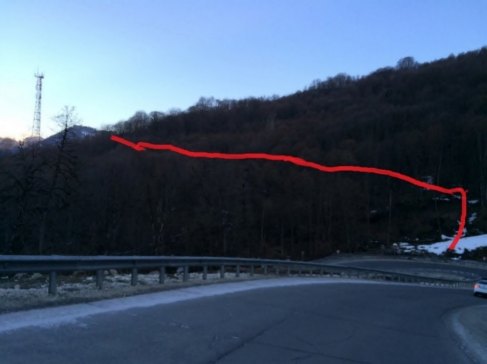
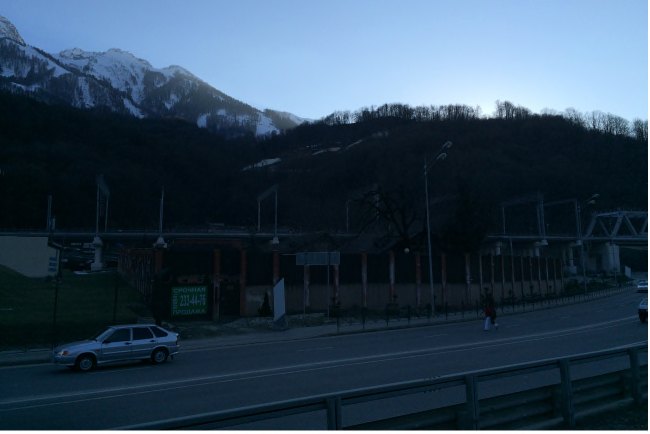
The radio tower, and the perspective from above — close to the top of
Gornaya Karousel, with the main road at valley level.The later part of the journey along the dirt road, in red — beginning at
the first stream and ending at the second.
It turned out that this was the road from the valley floor (where I was staying) up to the
Gornaya Karousel resort, but which is mainly used by the wealthy with dachas above, or their
delivery men. The common folk stay down in the (cheaper) valley, and thus none of the
drivers whipping by in their Lexus’ and Mercedes’ cared to stop on a Sunday
night for a wet, gesticulating, disheveled American walking like Frankenstein down a road no
one walks on.
I Had Made It
I walked down the winding paved road for maybe another hour, thighs cramping, until I saw a
bridge which I knew was for the Sochi airport train that ran along the valley floor, as I
had taken it. I had made it down.
Another fifteen minutes and I reached my hotel; it was around 8:30 p.m. My hand was truly
opening the front door, something I had envisioned for hours. I HAD MADE IT! Too sore and
exhausted to be overwhelmed. I had trouble getting my boots off, as I was aching all over
and could not stretch to do so, and got some help from a concerned staff member. As my boots
came off, a lot of wet, blood-stained U.S. currency (around $2,000 — mostly 20’s)
fell out of the bottoms of the pants. I had been wearing a money belt, which had opened and
moved down my battered, cut legs inside of my jeans. The wild, apparently loaded, American
was given a plastic bag “forrr yourrr monney”; awkward moment. Hot shower;
crawled into bed.
Some real money laundering.
The Olympic Hospital
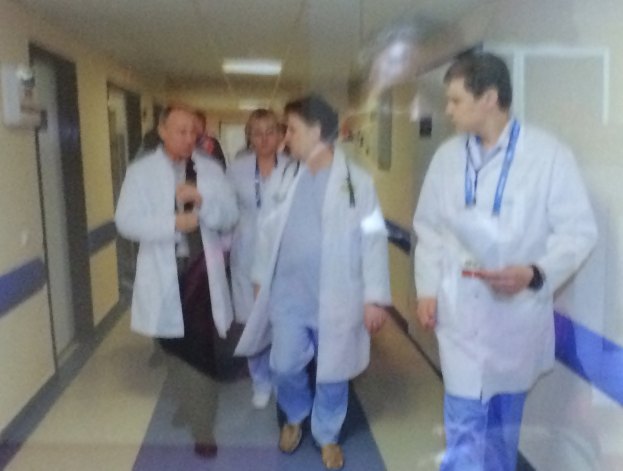
Subsequently, I went to the Olympic Hospital in the next town. This (out of focus) photo in
its lobby suggests that I was in the right place.2
In the lobby of the Olympic Hospital.
I was patched up by a nurse, and saw a doctor who told me I had frostbite on my swollen
fingers, and that I had to return every day to change the bandages.3 His English wasn’t so good, and I hoped that he had misspoken. Yet, a
U.S. doctor had told me via video that my fingertips (ring, middle) on my right hand looked
infected, i.e., she thought it likely that they needed to be partially removed, that there
was gangrene. (“Sorry for the bad news.”) Thankfully, it turns out that she was
an overly-cautious rookie on the graveyard shift, but she really shook me up then.
When I returned to the hospital, the doctor sent me to an adjacent clinic to see a surgeon.
A taciturn, 40-ish, blonde woman right out of “Dr. No” and
“S.M.E.R.S.H”, heels clicking militarily down the hall, commanded me to follow
her, then yelled at me (in Russian) because I was moving and undressing too slowly in what
was her combined office/examining room, and was too unimportant for her, a surgeon! (The fee
was $20.) I couldn’t move too fast and loudly told her so (in English), and then the
attending nurse, a plump 60-ish Russian woman who really does all the work, started yelling
at the surgeon. It was comedic, like something out of the barely functioning U.S.S.R. where
no one does any work and the workers have no respect for the bosses. In any event, the
surgeon calmed down, smiled, confirmed the frostbite, gave me a prescription for an
antibiotic, and now spoke softly (“Brrrooos” — Bruce) in Russian that I
had to change the bandages daily, take the pills twice a day, and be very watchful for any
infection. (I would have another chance encounter with the surgeon a day or so later where
she again started yelling at me — it was a Saturday, and she was only working half a
day and I was too late.)
I was happy to get away from “Dr. No” and return to the hospital for my daily
treatments, where the staff were much nicer. I became a “regular”, “that
American.” Though health care is very inexpensive, the hospital did not charge me, and
billed my travel insurance. When I tried to tip a very helpful nurse, she declined. When I
left 10 days later, I brought her a box of candy.
From Sochi, I flew to Moscow, then New Delhi, India where I saw an English-speaking plastic
surgeon who my insurance company had found. (Her daughter graduated from Harvard Med, and
ran a plastic surgery practice in Stamford, CT.) If I was going to lose part of my fingers,
I wanted to hear it in English. The doctor examined me and said, “Nature is a wonderful
thing; let’s let it take its course. I see some pink starting to come through (the tips
were black). If we start to cut now, we might actually take away good tissue. I say wait and
see how it goes; you may recover without any surgery.” That’s the same thing
that a NY plastic surgeon had told me who was only able to look at pictures. The Indian
doctor had seen, felt my fingers. What terrific news!4
Six Weeks Later
As I write this, it is some six weeks after the ordeal, and though the
“infected” two fingers are markedly improved and look like they will recover,
all of my fingertips remain without full feeling due to dead, callous-like skin which will
hopefully be naturally replaced over time.5 Thus, I have
no feeling in the fingertips, though the affected areas feel as though they have shrunken a
bit since the accident. It remains difficult to button a shirt, zip a zipper, put a hand in
my pocket. I have discovered that touch screen phones and computers generally have to sense
warm flesh — my fingers do not always meet that criteria, and sometimes just wind up
scratching the screen.
While I have concentrated thus far on my fingers, I also took a chunk out of my right
buttock from all the sliding, which would only hurt when I sat or slept, and really, really
hurt when they changed the bandage. (Thus my undressing in Dr. No’s office.) That has
now mostly healed, along with some other scrapes, bruises, loss of big toenails. The
soreness throughout my body remained for a while, making it difficult to move, stand, get
in and out of a car, and giving me greater sympathy for the elderly and the handicapped.
Nonetheless, after taking a week off, I returned to the slopes and skied (gingerly) for
several days (including my birthday) before heading for India.
If anyone is interested, there is a 20 minute YouTube video I made a week after my ordeal
which relates the story above.6 Balancing the bad times
with the good times, there is a “Back in the U.S.S.R.” video7 I made the night before the ordeal, courtesy of a “Moscow girl
who made me sing and shout.” Excuse my singing voice; the crowd seemed to like that an
American, courtesy of John, Paul, George and whatshisname, was making fun of the hopefully,
but maybe not actually, dead, Soviet Union, while they still really can’t.8 Paul sang it in Red Square in front of Putin, minus the white lab
coat.9 (Tell me who’s better.) What a good sport
that guy is.
Levity aside, this was the most challenging, dangerous event that I have ever experienced.
Me against the mountain. A real Survivorman episode. While I would never want to repeat it,
it demonstrated to me who I am and what I am made of, together with the fact that I was very
lucky. It was warm, there was no wind, rain or snow; I did not break anything. If I had, I
would have been stranded, and this story may never have been told. Again, no search parties,
no helicopters, a far-away ski patrol with the (Russian) attitude of, “You’re on
your own.” I don’t know that the Bruce of many years ago wouldn’t have gone
to pieces and given up.
The frostbite is a very small price to pay; the “insignificance” difficult to
shake. While I would like to end with something profound, let’s just say this is a
story with a happy ending.
Notes
Matt Mathes, a spokesman for the U.S. Forest Service’s Pacific Southwest
region. Los Angeles Times, Nov. 1, 2005. ↩
Some other articles — Huffington Post, Jan. 27, 2015: Julie Abrahamsen, the
Norwegian snowboarder who [ducked under rope] spent three icy nights in the Whistler
backcountry before being rescued. At one point, Abrahamsen tried to cross a frigid river,
ending up neck-deep in water. Several fortunate events factored into Abrahamsen’s
survival, said Whistler Search and Rescue manager Brad Sills. Despite heavy rain,
temperatures averaged 3 °C, which is warmer than normal. — Globe and
Mail, Dec. 14, 2011: Mr. Blackburn, then 51, and Ms. Fortin were on a ski vacation when
they ducked under the rope and went out of bounds at Kicking Horse resort on Feb. 15, 2009,
without adequate provisions or backcountry gear and got lost. They wandered aimlessly behind
the resort, traversed 27 kilometers along a river valley, and suffered through bitter wind
chills, fearing attack by wolves before they were found on Feb. 24. A rescue operation was
launched, but Ms. Fortin was dead. Mr. Blackburn was taken to hospital and treated for
frostbite. — Denver Post, Mar. 2, 2011: Two men died last month after leaving
ski-area access gates in search of untracked powder. As more skiers and snowboarders venture
through access gates atop most every ski area, calls for difficult-to-reach rescues are
climbing.
At least he isn’t heading into surgery bare-chested. ↩
The hospital is in an out of the way area with sporadic bus/taxi service. I was
generally the last person to be seen (triage, lots of injured skiers daily) at the end of
the day/evening. I rented a car. ↩
“Most people recover completely from frostbite, though the affected area may
be more susceptible in the future to discomfort from cold weather, repeat frostbite, and
damage from the sun.” — WebMD, First Aid. ↩
youtube.com/watch?v=9WDBfigntz4
— I had not yet performed the research detailed herein, and misstate in the video that
the descent was 3,500 vertical feet; it was 5,200 ft. ↩
A few items from RT Today, the Russian government’s (Putin’s) English
language TV/radio station: “A poll released today indicated that 86% of the Russian
people approve of the job President Putin is doing, which, by the way, is far better than
Obama’s numbers!”; “The 56th humanitarian convoy carrying food and clothing
entered the Ukraine today from Russia to assist the displaced and the elderly”; and,
of course, criticism of Obama. ↩